Postingan

Menampilkan postingan dengan label LABORATORY ANIMAL

Obese Animals: Complications of Anesthesia

Gambar
Obesity is described as an accumulation of excess adipose tissue as a result of a sustained positive energy balance. The high prevalence of overweight and obese companion animals may skew the perception of what is considered ideal body composition. Body Condition Score (BCS) is used most commonly in companion animals to assess body composition. In obese animals, clinical examination may be hindered, the chest may be more difficult to auscultate and the abdomen more difficult to palpate. Veins and arteries may be more difficult to identify when large amounts of subcutaneous fat are present. Pulses may be more difficult to palpate. Subcutaneous fat may make venous and arterial access challenging and correctly securing appropriately sized cuffs for noninvasive blood pressure measurement can be difficult. Increased subcutaneous fat may obscure identification of landmarks for regional anesthesia. Increased subcutaneous fat may result in poor drug delivery after inte...

I.V. Cannula Sizes and Colors

Gambar
I .V. cannula is a very small, flexible tube placed in the vein to allow administration of medication, fluids or nutrients directly into the bloodstream. The catheter is introduced into the vein by a needle, which is subsequently removed while the small plastic cannula remains in place. The catheter is then fixed by taping it to the patient's skin or using as adhesive dressing. I.V. cannula sizes and colors The smaller the gauge, the larger the diameter of the cannula and faster the flow of fluid. Different cannula sizes are indicated by different colors, making them easier to differentiate, especially in emergency situation in which size might be critical. Choosing the correct cannula size is important so that treatments can be carried out properly. Larger cannula sizes are necessary for rapid transfusion of blood, intravenous fluids and medications. Smaller cannula sizes result greater pressure in the vein. This can cause hemolysis during the aspira...

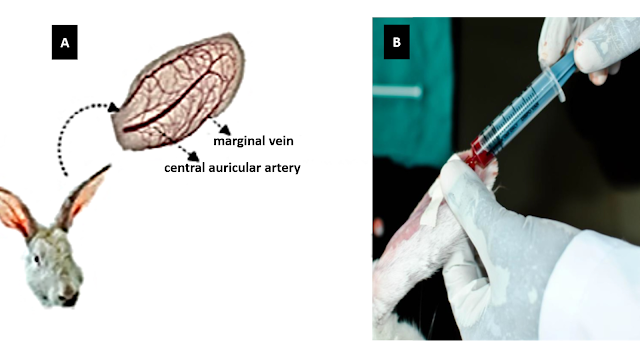
Protocol for Marginal Ear Vein / Artery Blood Sample Collection in Rabbit

Gambar
What volume of blood can be safely collected at any one time in a 2 kg pet rabbit? And how is this calculated? The maximum volume removed at any one time should not exceed 10% of the circulating blood volume. Total blood volume in a healthy rabbit range between 5.5-7% of body weight.  Therefore, in a 2 kg rabbit the total blood volume ranges between 110-140 ml and the maximum volume of blood that may be safely taken is 11-14 ml. A slightly lower volume may be prudent for juveniles, ill animals or suspected anaemic cases. Protocol for marginal ear vein / artery blood sample collection Requirements include animal, anesthetic agent, cotton, 26G needle, 95% v/v alcohol,  topical vasodilatator  (o-Xylene ), surgery blade and blood sample collection tube. The animal should be placed in a restrainer. Restrain rabbit securely with mechanical rabbit restrainer, towel wrap method or commercially available sacks. Ear is cleaned with 95% v/v alcohol an...

MONYET EKOR PANJANG (Macaca fascicularis)

Gambar
Pendahuluan Sejak tahun 70an, monyet ekor panjang  (MEP) yang dalam bahasa latin disebut  Macaca fascicularis   diekspor  dari Indonesia  untuk keperluan riset biomedik dan   penelitian psikologi .  Monyet ekor panjang ( Macaca fascicularis ) banyak  dimanfaatkan  sebagai  hewan  model  karena secara anatomi maupun fisiologi mempunyai kemiripan dengan manusia dibandingkan hewan  model  lain, sehingga untuk pengujian suatu obat atau bahan biologis akan mendapatkan gambaran yang mirip apabila digunakan pada manusia    (Sajuthi  et   al ., 1997). Karena jumlahnya yang terbatas, penggunaan primata ini dalam penelitian terbatas atau hanya digunakan dalam jumlah sampel yang sedikit, tidak seperti tikus atau mencit yang digunakan dalam jumlah yang besar. Gambar 1. Monyet ekor panjang   ( Macaca fascicularis )  (Primate info net, 2006). Klasifikasi Monyet ekor panjang...

TIKUS PERCOBAAN

Gambar
Pendahuluan Pemilihan hewan coba yang tepat dalam membuat model penyakit atau kondisi tertentu yang sesuai tujuan penelitian sangat mempengaruhi keberhasilan dalam penelitian tersebut. Tikus merupakan salah satu spesies hewan yang banyak digunakan dalam sebuah penelitian.  Data Biologis Tikus Data biologis tikus sebagai hewan coba penting diketahui untuk mengetahui data normal dan sebagai pembanding perkembangan tikus yang digunakan sebagai hewan coba baik sebelum perlakuan maupun setelah diberi perlakuan. Data biologis tikus berdasarkan  Smith dan Mangkoewidjojo (1987 ) yaitu sebagai berikut: L ama hidup : 2-3 tahun, hingga 4 tahun Lama produksi ekonomi : 1 tahun Siklus kelamin : poliestrus Berat lahir : 5-6  g Berat dewasa : 300-400 g jantan; 250-300 g betina Umur dewasa : 40-60 hari Umur dikawinkan : 10 minggu (jantan atau betina) Perkawinan : pada waktu estrus Siklus estrus (birahi) : 4-5 hari ...